The Fragile Elegance of XCOM


When I first played XCOM: Enemy Unknown over a decade ago, I was struck by how, despite being Firaxis's first attempt with the property, how fully realized it felt. It was one of those strategy games where every system felt carefully balanced around one another. Each resource - be it money, exotic alien materials, time, and the panic level of each country, had to be carefully balanced against one another, lest you fail in your campaign against the aliens. It's one of those games where I felt like nothing could be removed without taking away a vital piece of the puzzle. But more than on a pure strategy level, the game sells the concept of an international coalition of human beings rallying against a more advanced, unknown enemy.
At the end of XCOM 1, it was heavily implied that the entire point of the alien invasion wasn't strictly for domination, but as a very rude way of getting humanity ready for an even greater threat that loomed further out in space. The aliens still wanted humanity under their heel, but at least they were giving us a chance of survival as soldiers in their empire.
This was an important conceit. It contextualized perfectly why the aliens didn't just overwhelm the globe with an all-out assault. Instead, they sent out targeted attacks on specific areas across the globe, and it was up to your global XCOM organization to learn more about enemy and turn the tide.
The 'learning your enemy' bit is the thematic core of XCOM. Despite being more violent than Star Trek, spiritually the two have a lot in common; they assert that what makes humanity special is our curiosity, our desire to learn and adapt. The strength of XCOM: EU is it makes you feel that thesis in the mechanics. When you start off in XCOM, your soldiers are dressed in mundane gear - ballistic guns and carbon fiber armor. But as you fight the aliens and study their corpses and technology, your scientists, lead by the morally dubious Dr. Vahlen, learn to co-opt their technology. After several in-game weeks making due with your Earth weapons, you start to manufacture laser weapons and super armor made out of exotic metals. Eventually your normal fighter jets are replaced by the awesome-looking Firestorm, a design that perfectly screams "What if a fighter jet and a UFO met in Paris":
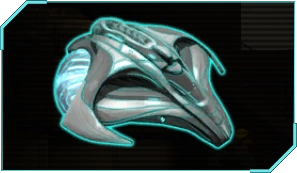
And none of it is for show, of course - the laser weapons do more damage, the carapace armor keeps your troops alive (assuming you don't send one into a nest of Mutons on accident), and the Firestorm knocks UFOs out of the sky with ease. It's standard video game progression, clearly, but it's elevated by the execution of conquering the unknown. It's in the name: The enemy represents the unknown, as aliens usually do, and winning the day will require making them known.
A secondary theme is the spiritual danger inherent to this; Dr. Shen, XCOM's engineer, often chirps in with his anxieties about what co-opting this technology will mean for humanity once this is all over. After all, we've been thrust hundreds of years into the future of weapons technology, up to and including modifying your soldiers with psychic powers. When the aliens are finally dead, is what's left even human anymore? It's the if you stare too long into the abyss, the abyss stares into you song-and-dance, but instead of this kind of alien:
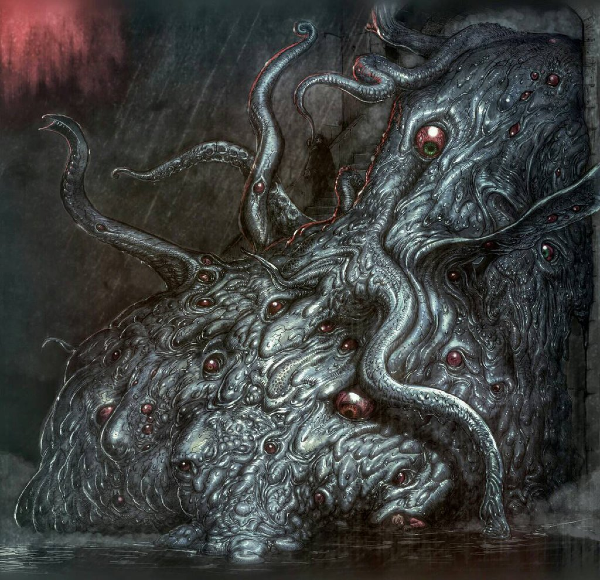
It's this kind of alien:

On the other hand, Dr. Vahlen represents the opposing view of I don't give a shit, we have greys to kill. At the end of the day the game more or less agrees with her. It's in your best interest to use all the toys available to you to win, and the game ends before society can have a serious meditation on what to do next with our fancy new laser guns and mind control powers.
But either way, for a game about pointing guns at monsters and missing when it counts, the game is laser-focused in approaching its premise. It's paced really well, too; if you play on hard like I did, every victory feels well-earned, and each new piece of technology you earn feels like a genuine triumph for humanity. XCOM:EU isn't high literature, or anything, but there's an undeniable fuzzy feel-good feeling about slowly catching up to those dastardly aliens; you feel humanity's ingenuity as you arc through the game, co-opting and inventing your own spin on alien technologies, especially since these technologies have tangible, powerful effects on your ability to win the day. It's a sort of advanced power fantasy; it's not just that your guys can blow up the other guys, it's that humanity has the superpower of adaptation, and the game is an effective ode to that.
All these years later I had the itch to go back to the franchise - but specifically the first Firaxis one, not XCOM 2, for reasons I'll get to some other day. But I'd never tried the well-received Enemy Within expansion pack or the smaller narrative DLCs, so I decided to give them both a go.
What I quickly realized is that while these DLCs are well-made for what they are, they all disrupt the careful elegance of the vanilla experience.
Let's start with the biggest expansion, Enemy Within. In addition to several gameplay additions, the premise of Enemy Within is that, in addition to the alien threat, there's a human faction on the enemy side called EXALT. (Whenever I think of needless capitalization in games, I always flash back to B.L.O.O.D.M.O.S.E.S. from the best game ever made, Barkley: Shut Up and Jam: Gaiden.)
EXALT is here to engage you in spy games; they like to steal your resources and you have to send spies to their hideouts to track them down. When you find them, you switch to your usual tactical combat mode to fight - but this time, since they're human, they use very similar tactics to you. I was delightfully blindsided the first time I saw one of the EXALT heavies take out his rocket launcher and deal six damage to two of my units at once.
I get the design impulse to add humans to your roster of enemies. After all, the developers already created all the tech and animations for your units. It would take far fewer man hours to develop enemies that act the same way as yours do. And it is genuinely engaging to fight an evil reflection of XCOM.
The main issue I have with EXALT is that it smacks of a sidequest. While they're in league with the aliens, they don't seem to work with the aliens, and thus all of their interactions - the loss of resources, sending your spies, cleaning up their bases - feels disconnected from the main conflict. Look at it this way - if you had to write a logline for Unknown, it would go something like:
"When aliens attack the earth, you're put in control of an international military organization specializing in reverse-engineering alien tech to fight them."
If you were to write a logline for Within, it would go like:
"When aliens attack the earth, you're put in control of an international military organization specializing in reverse-engineering alien tech to fight them. Also, some asshole humans are there too."
The other, more petty complaint I have about EXALT is that they look like doofuses.
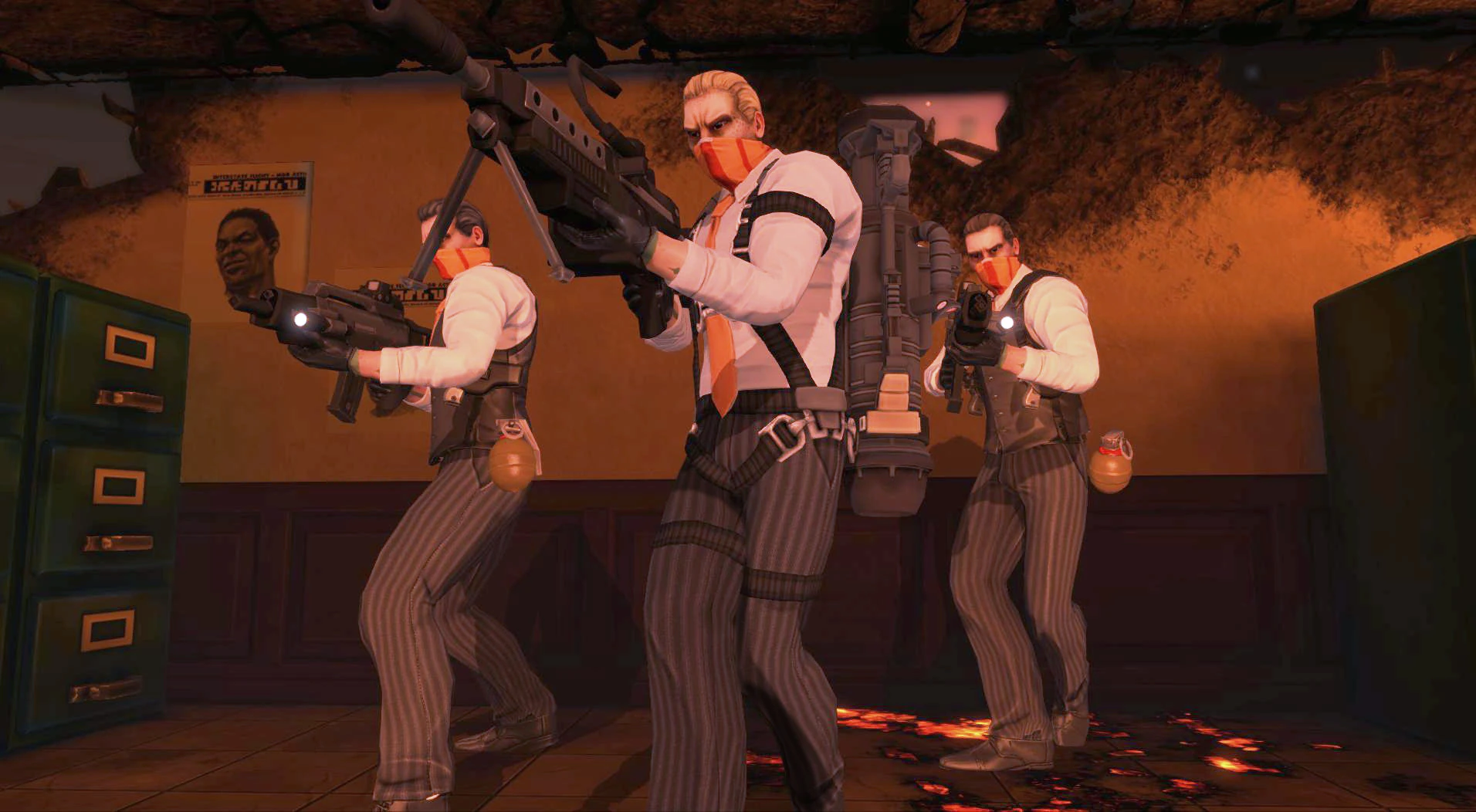
They wear a weird hybrid of paramilitary gear - the bandanas, weaponry and tactical straps - with 1960's pinstripe suit aesthetics. This is all an apparent tie-in to The Bureau: XCOM Declassified, the tactical shooter prequel released a few months before Enemy Within. If you're into the deep lore of these games, more power to you, but within the context of XCOM, they just look stupid. Why are they going into a warzone dressed like Al Capone, yet have the same hitpoints as my dudes with military carbon fiber?
A common argument I hear whenever I whinge about aesthetic consistency goes something like: this game already has goofy grey aliens and dudes who are basically living jetpacks. Why are we drawing the line at pinstripe gangster terrorists?
I hold this line of thinking in utter contempt. It assumes that all breaks from reality are created equally. In good fantasy and sci fi, your breaks from reality still need to retain the specificity of your core idea. If the festival musicians at the beginning of Lord of the Rings inexplicably played EDM music, it would break all plausibility, even though it's a world with dragons, giant spiders, and morally righteous monarchies. The core concept of XCOM is that you're fighting pastiches of 1950's b-movie aliens, but made to be actually threatening. Giving the cast of The Sting a bunch of rocket launchers doesn't do it for me, dog.
Enemy Within has further problems than EXALT, though. The two big gameplay features are a new soldier class in the form of MECs - cyborgs, basically - and a new talent tree to augment your non-MEC soldiers, Gene Mods.
My issue with these is less in the concept and more in the timing. Both of these features necessarily need to be given to the player early - they both spend the new resource, MELD, and MELD is retrieved from nearly every mission from the start. They're from caches placed deep into the maps, and you have to grab them within a handful of turns or it's lost. The developers want to engage you in a game of risk-reward: You can sprint to get that sweet sweet MELD, but you're likely to trigger enemy spawns before your entire squad is in a good position to fight them properly. It's the early version of the strictly timed missions in XCOM 2.
Because you get these toys right away, the pacing of one of the major themes of the game is disrupted. As mentioned earlier, Shen's angst about the danger of alien technology grows throughout the game. Eventually, he and Dr. Vahlen both are unsure what to make of a world post the invention of psychic powers. Indeed, psychic powers in Unknown marked a certain point of no return - the point where our reverse engineering hasn't just created fancier new weapons, but has altered what our understanding of what a human even is. As of Within, though, you get the ability to splice genes and make cyborg super soldiers immediately. No slow arc, no buildup, humans are just freaks right away. Hell, as soon as you finish the Seeker autopsy, you can somehow reverse engineer a robot's cloaking technology into chameleon skin for humans.
So that's my grievance with Enemy Within. It sacrifices some thematic elegance for strategic depth, which I'd guess for most players is a tradeoff they're willing to accept. On balance, I, too, have to admit that there's a lot to like if you gloss over what the expansion disrupts.
What I think is utterly worthless, though, are the story mission DLCs.
The game has two small story DLCs: a standalone DLC called Slingshot, and a tie-in with Enemy Within called Operation Progeny. My issue with these are pretty simple; they act in defiance of what makes their own game special.
The story of XCOM is intentionally very barebones - aliens attack, you're in an organization meant to stop them. Purely plot-related complications ensue - it turns out your team needs to capture aliens to find their hidden bases. You learn how to capture aliens and manage to capture a specific one that can create a key to find the base. Once in the base, you discover what's needed to make psychic soldiers. So on, and so forth. The three named characters do emote somewhat, but only in relation to the plot; they have almost no interiority at all.
You might think this is a bad thing, and in many games it would be. But XCOM achieves its humanity in a different sort of way: The player's innate roleplaying instincts. All of your soldiers are procedurally generated with a random gender, appearance nationality, name, and eventually once they rank up - class.
The game itself doesn't do much to characterize the squaddies. While there are several different voices per gender, they all share a limited pool of voice lines, characterizing them all as broadly enthusiastic gung-ho marines. The result is that your guys become a blank slate for the player to fill in themselves. This is further enriched by the random noise of the gameplay - certain squaddies might make a 30% chance shot when it really counts, or miss a 90% shot and spell certain doom - memorable, emergent events that can be fed back into the roleplaying. Many of us probably ended up with a badass sniper by the end, but only I had a Swedish lady nicknamed Spider who was an aloof mother to her men and always landed her shots when it counted, and was bitterly disappointed with herself when it turned out, despite her tremendous skills and will, that she wasn't psionically gifted.
It becomes obvious, then, what my issue is with the story DLCs - it fills in these blanks for you. In Slingshot, you get a pre-scripted ex-triad member named Zhang who defected from the mob to help save the world. In Operation Progeny, you save a psychically-gifted french woman named Annette, who despite having no formal military training, decides to join up with XCOM.
Both units have a specific look and voice lines; they're set in stone. To some, this might be a good thing - it adds some variety to the generic soldiers. To me, this removes one of the core things that makes XCOM special. We're not supposed to be handed special hero units with backstories. We're supposed to make our own.
But beyond that, the missions you get these characters in also break up the rhythm of the main story. I'm not sure if they replace existing mission events or are slotted alongside them, but in either case they disrupt the simulationist bent of the game - they bloat up and confuse the otherwise random feeling of the aliens striking across the globe, adding explicit story to a game whose story beats should be almost entirely emergent.
Unlike Enemy Within at large, I don't see any positives to the story missions. I'll never play with them again; thankfully, they can be easily disabled before starting a new campaign.
In other media, we seem to understand that brevity is the soul of wit. Movies are ruthlessly cut for time unless they're lucky enough to get a director's cut (okay, actually a lot of modern blockbusters buck this trend, but it's shitty so my point stands). Poetry, too, is often an exercise in evoking your feeling as efficiently as possible. Video games, by contrast, are too often judged by how much stuff is in it, not necessarily how well that stuff holds together. Enemy Unknown's DLCs attempt to add more 'stuff' while scuffing the elegance of the vanilla game.
It's difficult to grasp why this is. Perhaps I'll get into it in a different post - I have some ideas, but they're all half-formed, and this post is long enough already. All I know is that the EXALT guys look dumb and I don't like them, and Zhang isn't as cool as he thinks he is.
At least they didn't fuck it up as bad as XCOM 2.
